Don’t Let Storm Chasers Steal Your Crew: The Modern Roofing Owner’s Guide to Retention

It’s the call every roofing company owner dreads. You’re at 90% completion on a high-profit TPO job downtown. The client is happy, the timeline is on track, and then your project manager calls with a knot in his stomach. “The crew is gone,” he says. “A storm chaser rolled up to the site, flashed a stack of cash, and lured them away for a hail job two towns over.” The truck is empty, the site is a mess, and your phone is about to ring with a very unhappy client on the other end.
This isn’t just a hypothetical nightmare; it’s a harsh reality in the roofing industry. The transient nature of storm-chasing operations creates a volatile labor market where loyalty is often sold to the highest, most immediate bidder. For established, reputable roofing companies, this “poaching” is more than an inconvenience. It’s a direct assault on your profitability, your reputation, and your ability to scale.
But what if you could build a business so strong, a culture so magnetic, that your crews wouldn’t even entertain those cash offers? It’s not about matching dollar for dollar in a race to the bottom. It’s about building a strategic moat around your business, one founded on operational excellence, a powerful brand, and smart marketing that makes you the contractor of choice for both customers and crews. This guide will show you how.
Defining the Crisis: When Your Biggest Asset Walks Away
The problem of crew poaching goes far beyond a simple labor shortage. It’s a targeted strike against your operational stability. When a crew walks off a job mid-project, it triggers a catastrophic chain reaction. The immediate problem is an unfinished roof, exposed to the elements, and a broken promise to a client. But the fallout spreads quickly, impacting every facet of your business.
Imagine a $40,000 residential roof replacement. The crew leaves when the job is 75% complete after being offered $500 more per person, in cash, for a week’s work on a hail-damaged neighborhood. Suddenly, your company is facing:
- •Immediate Project Paralysis: You must scramble to pull another crew, delaying their scheduled job and creating a domino effect of scheduling conflicts.
- •Massive Cost Overruns: You’re now paying premium rates to find a replacement crew, potentially covering overtime, and absorbing the cost of materials that may have been damaged or wasted in the interim.
- •Legal & Contractual Jeopardy: Your client contract has a completion date. Missing it can lead to penalties, disputes, and even legal action.
- •Reputation Damage: The original client is now a disgruntled client. They won’t just complain to you; they’ll go to Google, Yelp, and the BBB, leaving a one-star review that poisons the well for future customers.
This isn’t a minor hiccup; it’s a full-blown business crisis. A single poached crew can erase the profit margin of a job and inflict long-term damage on the brand you’ve worked so hard to build.
The Root Causes: Why Roofing Crews Chase Storms
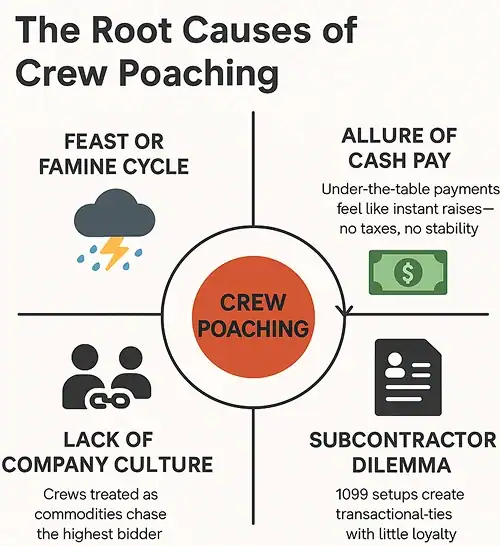
- •The “Feast or Famine” Cycle: The roofing industry is heavily event-driven. A major hail or wind storm creates a massive, sudden demand for labor. Storm chasers, who have no long-term overhead in the area, can afford to offer inflated, short-term cash pay because their business model is entirely opportunistic.
- •The Allure of Under-the-Table Cash: Cash payments are tempting because they are immediate and can go unreported. For some workers, this sidestepping of taxes and official payroll feels like a significant pay bump, even if it offers zero stability or benefits.
- •The Subcontractor Dilemma: Many roofing companies rely heavily on 1099 subcontractors rather than W-2 employees. While this model offers flexibility, it inherently fosters a transactional relationship. If the only tie a crew has to your company is a paycheck, they have little reason not to jump ship for a bigger one.
- •A Lack of Company Culture: When a crew feels like a disposable commodity rather than a valued part of a team, their loyalty will be non-existent. Without a sense of belonging or a shared mission, the highest bidder will always win.
The Bottom-Line Impact of Crew Turnover
The consequences of crew abandonment are severe and multifaceted. They ripple through your finances, operations, and brand reputation, often causing damage that lasts long after the project is finally complete. A business built on a shaky foundation of unreliable labor can never achieve sustainable growth.
Let’s break down the true cost.
| Impact Area | Immediate Consequences | Long-Term Damage |
|---|---|---|
| Financial | Cost to hire and deploy a new crew. Overtime pay to meet deadlines. Potential client discounts or penalties for delays. Wasted or damaged materials on the abandoned site. | Erased profit margins. Inability to accurately forecast project costs. Stunted cash flow, limiting growth investment. Increased insurance and bonding costs. |
| Operational | Massive scheduling disruptions and project backlogs. Reduced quality control with unfamiliar replacement crews. Project manager’s time wasted on crisis management instead of growth activities. Increased safety risks from rushing to finish jobs. | Inefficient project pipeline. Inability to take on more or larger projects. Burnout among key management staff. Systemic breakdown of project management processes. |
| Brand & Reputation | Angry client and negative online reviews. Damage to relationships with suppliers and GCs. Word-of-mouth reputation shifts from “reliable” to “risky.” | Lower lead conversion rates. Loss of valuable referral business. Difficulty attracting high-quality, stable talent. A weakened brand that must compete on price instead of value. |
As the table shows, losing a crew isn’t a one-time cost. It’s an anchor that drags your entire business down, making it impossible to build the momentum needed for market leadership.
The Solution: Building a Retention-Focused Roofing Business
Beating the storm chasers isn’t about playing their game. It’s about creating a better one. You need to build a business where the stability, culture, and opportunity you offer far outweigh the short-term allure of a cash payout. This requires a two-pronged approach: strengthening your internal operations and leveraging your external marketing.
Part 1: Operational Fortification
- •Rethink Your Compensation Model: Go beyond the hourly rate.
- •Project Completion Bonuses: Offer a significant bonus that is paid out only when the project is successfully completed to company standards. This incentivizes finishing the job.
- •Performance & Safety Incentives: Reward crews for efficiency, quality (passing inspection the first time), and maintaining a safe job site.
- •Profit-Sharing for Crew Leaders: Turn your foremen into business partners. Giving them a small percentage of the net profit on the jobs they manage fosters an owner’s mindset
- •Foster an Unbeatable Company Culture:
- •Invest in Them: Provide top-tier safety equipment, professional training (like manufacturer certifications), and opportunities for advancement.
- •Recognition: Celebrate wins publicly. A “Crew of the Month” award, shout-outs in company meetings, and features on your social media show you value their work.
- •Respect Their Time: Pay promptly and reliably. Nothing destroys trust faster than delayed or inaccurate paychecks. Provide clear schedules and communicate changes proactively.
- •Consider the W-2 Employee Model: For your core crews, moving from a 1099 to a W-2 model can be a game-changer.
| Feature | 1099 Subcontractors | W-2 Employees |
|---|---|---|
| Loyalty | Transactional & low | High, part of the team |
| Control | Limited control over methods/schedule | High control over training & process |
| Cost | Lower upfront (no payroll tax/benefits) | Higher upfront (taxes, insurance, benefits) |
| Long-Term Value | Volatile & unpredictable | Stable, skilled, and invested in company success |
Part 2: Marketing as a Retention Tool
Your marketing isn’t just for attracting customers; it’s for attracting and retaining talent. A strong brand makes your company a place people want to work.
- •Showcase Your Team: Use your website and social media to highlight your crews. Post photos from completed jobs, introduce team members, and share testimonials from your employees. This builds pride and shows potential hires you value your people. This is a core tenet of effective Roofing Contractor Content Marketing.
- •Build a “Careers” Powerhouse: Create a dedicated, professional careers page on your website. Detail your company culture, benefits, and the type of professionals you’re looking for. Optimize this page with Roofing Contractor SEO to attract local talent searching for stable roofing jobs.
- •Leverage Your Reputation: A storm chaser has no local reputation. You do. Promote your hundreds of 5-star reviews and A+ BBB rating as proof of your stability and long-term vision. The best installers want to work for the best companies. Your online presence, supercharged by Google Business Profile Optimization, is your greatest recruiting asset.
Case Example: How Legacy Roofing Stopped the Bleeding
Legacy Roofing, a respected contractor in a storm-prone area of North Texas, faced a crisis. Every time a hail storm hit a neighboring county, they’d lose at least one of their top subcontractor crews. The owner, Maria, was tired of the constant disruption.
Instead of trying to match the cash offers, she implemented a “Retention & Reputation” strategy.
- •Introduced a tiered bonus system: 5% bonus for on-time completion, another 5% for passing inspection with zero punch-list items, and a year-end bonus tied to company profitability.
- •Launched a marketing campaign centered on her crew: She hired a professional videographer to create a “Day in the Life of a Legacy Roofer” video for her website and social channels.
- •Overhauled her careers page: She added testimonials from her longest-serving crew leaders and clearly outlined the path from installer to crew leader to project manager.
Within one storm season, Legacy Roofing’s crew turnover dropped by over 70%. Furthermore, they received three unsolicited applications from experienced installers who were “tired of the storm-chasing chaos” and wanted to join a stable, professional team. Maria turned her biggest vulnerability into a competitive advantage.
Build a Business That No One Wants to Leave
Losing your crews to fly-by-night storm chasers is a symptom of a deeper issue. It’s a sign of a transactional business model in an industry that desperately needs relational strength. By focusing on building an internal culture of respect and opportunity, and by amplifying that culture through smart external marketing, you can build a fortress around your talent.
You protect your business not by hoarding your crews, but by making your company the best place to be. When your team is valued, respected, and sees a future with you, the flash of a storm chaser’s cash will look less like an opportunity and more like a distraction.
Stop letting competitors dictate your stability. It’s time to build a brand that attracts and retains A-players, ensuring your projects are completed on time, your profits are protected, and your reputation continues to shine.
Ready to build a brand that top talent and high-profit customers can’t ignore?
Schedule your free, no-obligation strategy session with our team today. We’ll show you how a comprehensive marketing system can solve your biggest growth challenges, from lead generation to labor retention.
Book A CallFrequently Asked Questions
In the short term, it might seem that way. But in the long run, it’s incredibly expensive. You have no control, no loyalty, and immense liability risk (uninsured worker injuries, tax audits). The cost of one abandoned job, including project delays, penalties, and reputational damage, far exceeds the cost of investing in a stable, professional crew.
Marketing is about building a brand, and a brand is a magnet. By using marketing to showcase your company as a great place to work, you shift from constantly chasing labor to attracting it. The best installers want to work for reputable, stable companies that value them. An effective Roofing Marketing Strategy builds that reputation publicly, making you the obvious choice for top talent.
Even with subcontractors, you can build a strong culture. It comes down to respect, reliability, and partnership. Always pay on time, every time. Provide clear scopes of work and realistic schedules. Invest in their success by hosting manufacturer training days. Offer performance bonuses and consistently bring them profitable, well-organized jobs. Make their job as easy as possible, and they will prioritize working with you.
Not at all. It’s often a sign of rapid, explosive growth, a “good problem to have.” However, it is also a major risk indicator. Viewing it as a growth signal rather than a failure allows you to focus on the right solution: implementing financial systems and marketing strategies that can sustain that level of growth without breaking your business.
Start a conversation. Take your crew leaders to lunch and ask them what they value most. Is it more money? More predictable schedules? Better equipment? Better organization on the job site? Showing you genuinely care about their needs is the first step. Combine that with a tangible change, like implementing a project completion bonus, to show you’re serious. This immediately changes the dynamic from transactional to relational.