Insurance Denied Code Upgrades? Turn Your Biggest Headache into a Competitive Advantage
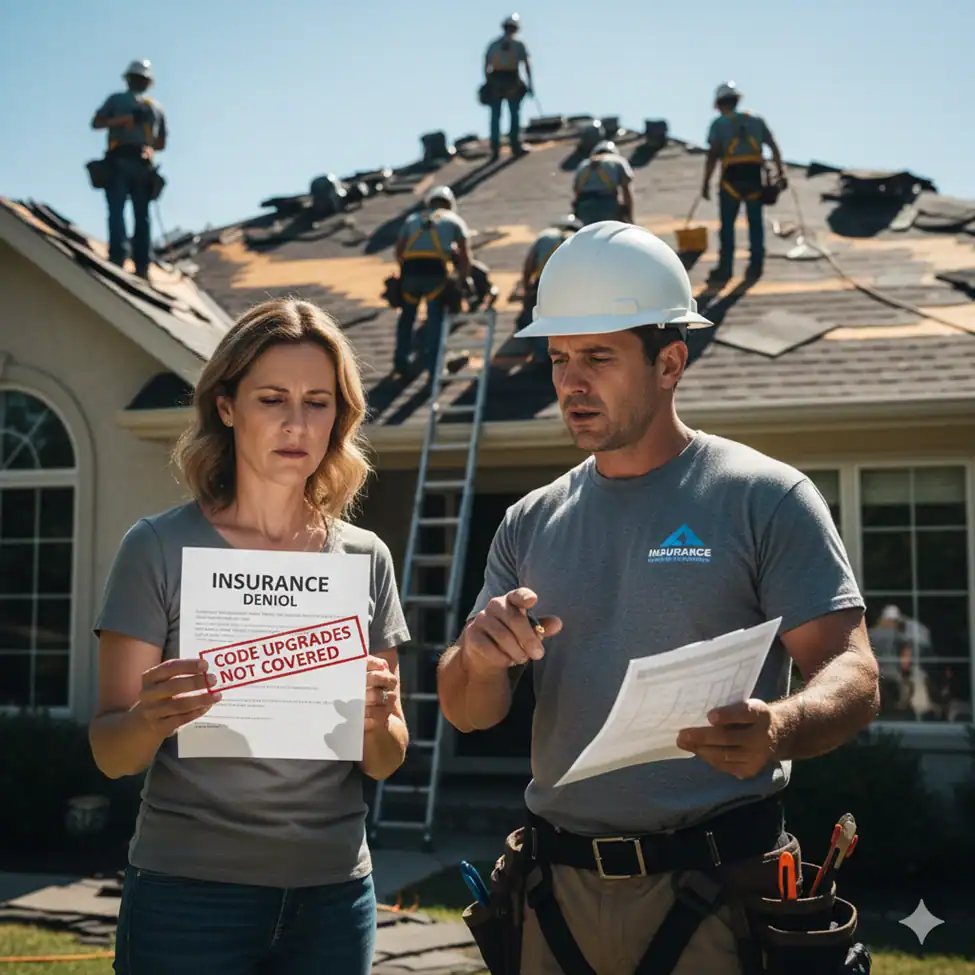
You’ve been here before. You spend hours on an inspection, build instant rapport with the homeowner, and expertly navigate the initial claim process. The job is yours. Then, the adjuster’s report lands, and it’s missing a crucial line item: the $2,000 needed to bring the roof up to current local building codes.
The homeowner, who has been nothing but pleasant, waves a hand dismissively. “Don’t worry about it,” they say with confidence. “My insurance will cover everything.”
Your stomach sinks. You know it’s not that simple. Now you’re faced with a painful choice: absorb the cost and decimate your profit margin, fight a drawn-out battle with both the carrier and the homeowner, or risk losing the job altogether. This single issue, the gap between a homeowner’s assumption and the reality of their policy, is one of the most persistent profit killers in the roofing industry.
But what if you could transform this common frustration into a powerful tool for building trust and closing more profitable deals? This isn’t just an operational problem; it’s a marketing and sales opportunity in disguise. In this guide, we’ll break down how to master the code upgrade conversation, protect your bottom line, and position your company as the go-to expert in your market.
The Code Upgrade Gap: When “Covered” Doesn’t Mean “Complete”
The core of the problem lies in a fundamental misunderstanding of standard insurance policies. When a homeowner’s policy promises “Replacement Cost Value” (RCV), they hear “brand new roof, no matter what.” As a contractor, you know the reality is far more nuanced.
Most standard homeowner policies are designed to restore a property to its pre-loss condition using “like kind and quality” materials. They are not designed to pay for improvements. Bringing a roof up to a new, stricter building code is, in the eyes of many carriers, an improvement, not a repair.
Consider these common scenarios where denials occur:
- •Drip Edge Requirements: A home built 15 years ago may not have had a drip edge installed. If the local municipality now mandates it on all new roofs, the carrier may deny the cost, arguing the original roof didn’t have one.
- •Ice and Water Shield: Many northern states have updated codes requiring multiple feet of ice and water shield at the eaves. A policy might only cover replacing the old felt paper that was there before.
- •Ventilation & Fastening: Codes for attic ventilation or nail patterns in high-wind zones (like Florida or Texas) are constantly evolving. The cost to add new vents or use more fasteners per shingle is a classic point of contention.
Industry estimates suggest that discrepancies related to code compliance can arise in as many as 1 in 3 storm restoration claims, turning a straightforward project into a complex negotiation that puts your company squarely in the middle.
Why Does This Keep Happening? Unpacking the Root Causes
This isn’t a new problem, but it’s getting worse. Understanding the underlying drivers is the first step to building a strategy to overcome it.
Vague Policy Language & The “Law and Ordinance” Clause
The key to code upgrade coverage lies in a policy endorsement often called “Law and Ordinance” or “Ordinance or Law” coverage. This is a specific add-on that provides coverage for the costs associated with complying with current building codes after a loss. Unfortunately, many homeowners either don’t have this endorsement, have it with very low limits (e.g., capped at 10% of the dwelling coverage), or have no idea what it is until it’s too late.
The Homeowner Information Disconnect
Your customer is an expert in their field, not insurance. They are targeted by broad marketing campaigns from carriers promising to “get you back to normal.” This creates a powerful, and incorrect, assumption that the insurance company is their partner in getting the best possible roof. They see you, the contractor, as the one introducing new costs, not the policy as the source of the limitation.
Constantly Evolving Building Codes
Municipalities and states update their building codes every few years, often in response to severe weather events. A roof that was fully compliant a decade ago may now require significant changes to meet today’s safety and durability standards. This constant evolution ensures that the gap between the “old roof” and the “new, compliant roof” will always exist.
More Than Just a Headache: The Business Cost of Code Upgrade Denials
Failing to have a bulletproof process for this issue doesn’t just cause frustration; it directly impacts your company’s financial health, operational efficiency, and long-term reputation. The consequences ripple through every part of your business.
| Impact Area | Financial, Operational, and Brand Consequences | |
|---|---|---|
| Financial Impact | • Shrinking Margins: You either absorb the cost of code items to save the deal, directly eating into your net profit. • Delayed Payments: Projects stall for weeks while you negotiate with adjusters and homeowners, wrecking your cash flow. • Lost Jobs: Homeowners faced with an unexpected $1,500-$3,000 bill may back out, wasting your sales and administrative time. | 🔴 Severe |
| Operational Impact | • Project Delays: Stalled jobs throw your entire crew schedule into chaos, creating inefficiencies and overtime costs. • Increased Admin Burden: Your team spends countless unbillable hours on extra phone calls, paperwork, and supplement documentation. • Resource Misallocation: Your best project manager is tied up resolving a conflict on one job instead of overseeing three others. | 🟡 Moderate-High |
| Brand & Reputation | • Negative Online Reviews: The homeowner feels misled and blames you. A single one-star review can say, “They promised insurance would cover it, then hit me with a surprise bill!” • Reduced Referrals: An unhappy or stressed customer will never become a source of valuable word-of-mouth referrals. • Damaged Trust: You are forced into the position of being the “bad guy” who delivers the bad news, eroding the trust you worked so hard to build. | 🔴 Severe |
From Problem to Process: A Blueprint for Managing Code Upgrade Issues
To win this battle, you need to shift from being reactive to being proactive. The solution is a blend of operational discipline and strategic marketing that positions you as an expert guide.
Operational Overhaul: Educate Early and Often
Stop treating code upgrades as a surprise and start treating them as an expected part of the process. This requires a fundamental shift in your sales and onboarding workflow.
| Traditional (Reactive) Approach | Modern (Proactive) Approach |
|---|---|
| Discuss code items after the adjuster’s report comes back. | Address potential code requirements during the very first inspection. |
| Rely on verbal explanations and hope the homeowner understands. | Provide a branded, easy-to-read “Code Upgrade Information Sheet” with links to local municipal codes. |
| Submit a supplement and wait for the carrier’s response. | Proactively build a supplement case with clear photos, code documentation, and precise line items before the job is even approved. |
| Deal with conflict and confusion as it arises. | Document every conversation in your CRM and have the homeowner initial a “Code Acknowledgment” form. |
By front-loading the education, you reframe the conversation. It’s no longer you vs. the homeowner; it’s you and the homeowner vs. the insurance policy’s limitations.
Marketing as a Solution: Build Trust Before the Sale
Your expertise on this issue is a powerful marketing asset. Use it to differentiate your company from competitors who avoid the tough conversations.
- •Content Marketing: Create blog posts and videos that you can use as sales tools. Imagine sending a homeowner a link to your article, “Does Insurance Really Cover Everything? Understanding Code Upgrades in [Your City],” before you even present a contract. This establishes authority and transparency. Our Roofing Contractor Content Marketing services specialize in creating these exact assets for your business.
- •Website Optimization: Dedicate a section of your website to “Our Insurance Claim Process.” Use a simple infographic to show the steps, including a specific point for “Code Compliance Review.” This pre-sets expectations for anyone visiting your site.
- •Google Business Profile: Use Google Posts to share tips about navigating insurance claims. A post titled “3 Questions to Ask Your Insurance Agent About Your Roof Claim” positions you as a helpful expert and can improve your local search ranking. Optimizing this is a core part of our Google Business Profile Optimization
Case in Point: How Pro-Line Roofing Turned Confusion into a Competitive Advantage
Pro-Line Roofing, a contractor in a storm-heavy region of Texas, was consistently bogged down by code upgrade disputes. Their project timelines were slipping, and their online reviews were starting to mention “surprise costs.”
They implemented a new, education-first strategy:
- •They Created a “Code Compliance Packet”: This simple folder, given to every homeowner at the initial appointment, included a one-page explanation of Law & Ordinance coverage, a list of common local code requirements, and a short FAQ.
- •They Filmed a 2-Minute Explainer Video: Their owner stood in front of a roof and explained the difference between a standard replacement and a code-compliant replacement. They put this video on their website and their sales team texted it to homeowners.
- •They Role-Played the Conversation: The sales team practiced how to introduce the topic positively, framing it as, “Our job is to make sure you get a safe, fully compliant roof that protects your investment, and we want to be transparent about how we get there.”
The results were transformative. Within six months, Pro-Line reduced project delays from code disputes by 50% and saw a 15% increase in 5-star reviews specifically mentioning their honesty and thorough process. They didn’t just fix a problem; they created a unique selling proposition.
Stop Fighting Fires and Start Building Your Brand
The gap between homeowner expectations and insurance reality on code upgrades will never disappear. You can continue to treat it as an unavoidable, job-by-job fire fight, or you can reframe it as a defining part of your business process.
By embracing proactive education, transparent communication, and strategic marketing, you do more than just solve a problem. You build a powerful reputation for honesty and expertise. In a crowded market, that reputation becomes your single greatest asset, attracting higher-quality leads, justifying your prices, and creating customers who become advocates for your brand. This isn’t just about protecting your margins; it’s about building a more resilient, profitable, and respected roofing company.
Ready to turn your operational expertise into a lead-generating machine? Your customers are searching for a trusted guide, not just another contractor. At kingcontractor.com, we build Roofing Marketing Strategies that establish your authority and turn your process into your promise.
Schedule a no-obligation strategy call with our team today to discover how we can help you dominate your market through expert positioning and intelligent marketing.
Book A CallFrequently Asked Questions
Frame it as a mark of your professionalism. Say, “Many contractors don’t even check for this, but we do it on every home because we are committed to building a roof that is 100% safe and compliant. Let’s look at what your local code requires together so we can create a complete plan for your insurance carrier.”
While it may seem like an easy way to close a deal, it’s a dangerous precedent. It devalues your work, destroys your profitability, and can even put you in a legally gray area regarding insurance claims. A better long-term strategy is to build a process that ensures these items are paid for correctly.
Provide them with the right tools: scripts, the marketing collateral mentioned above (PDFs, videos), and clear documentation from your production team. Confidence comes from knowledge. When they know the local codes inside and out and have professional materials to back them up, the conversation becomes much easier.
Documentation is your weapon. Use a software program that allows you to embed photos, circle specific code violations, and even include screenshots of the municipal code itself within your supplement report. A well-documented, professional supplement is much harder to deny than a simple invoice.