The Hidden Cost of a Hot Roof: How Heat Illness Is Inflating Your Workers’ Comp Premiums (And How to Fix It)
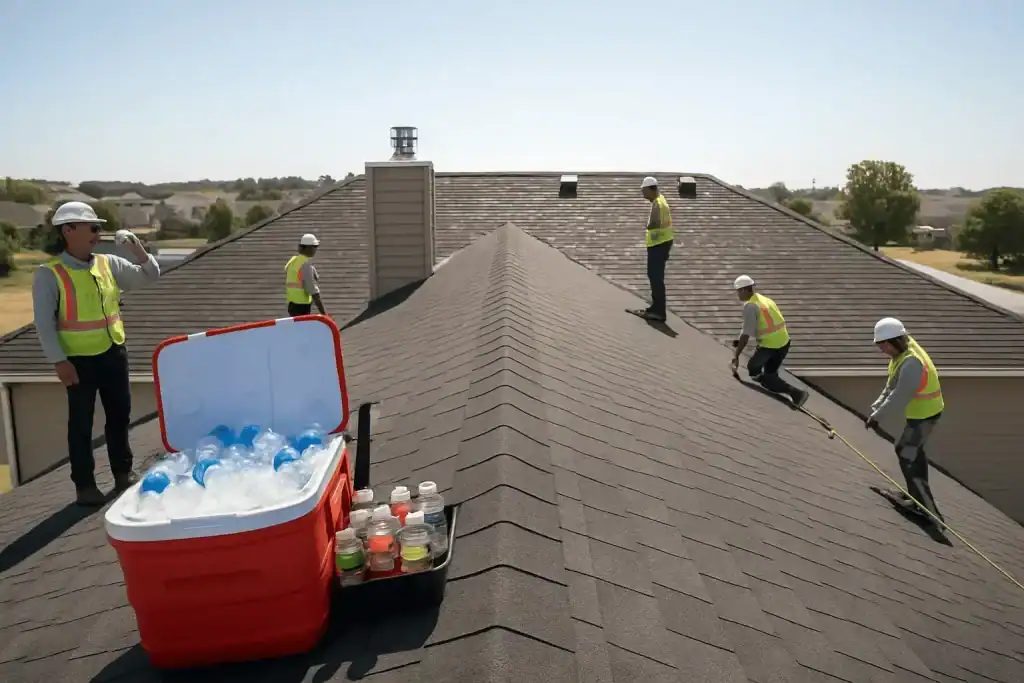
It’s renewal season. You open the letter from your insurance broker, and your stomach drops. Your workers’ compensation premium has jumped another 20%, the second year in a row. You start digging, and the culprit becomes clear: your Experience Modification Rate (EMR) is now a painful 1.18. The root cause? That heatstroke incident last August and another heat exhaustion case in July, both OSHA-recordable, both driving up your costs.
For roofing company owners, this scenario is becoming alarmingly common. The sun isn’t just a daily challenge; it’s the Hidden Cost of a Hot Roof, a direct threat to your profitability, your ability to bid on jobs, and your reputation as an employer.
This isn’t just a safety issue handled by your foreman. It’s a critical business problem that lands squarely on your desk. A rising EMR is a silent profit killer. But what if you could transform this vulnerability into a competitive advantage? This article provides a roadmap not just for controlling your premiums, but for turning a best-in-class heat safety program into a powerful marketing and recruiting tool that grows your roofing business. If you can name and manage the Hidden Cost of a Hot Roof, you can protect your crew and your margins.
The Silent Profit Killer: How Heat Illness Inflates Your EMR
Let’s break down the chain reaction that’s hurting your bottom line. At the heart of your workers’ compensation premium is your Experience Modification Rate (EMR), also known as your “mod rate.”
In simple terms, your EMR is a number that compares your company’s workers’ comp claims history to other companies of similar size in your industry.
- •An EMR of 1.0 is the industry average.
- •An EMR below 1.0 means your claims history is better than average, and you receive a credit or discount on your premium.
- •An EMR above 1.0 means your claims history is worse than average, and you pay a surcharge on your premium.
Here’s how a hot day on the roof translates into a higher bill from your insurer:
- •The Incident: A roofer suffers from heat exhaustion or, worse, heatstroke. They require medical attention beyond basic first aid.
- •The Recordable: The incident becomes an OSHA-recordable illness. According to OSHA, thousands of workers become sick from occupational heat exposure every year.
- •The Claim: A workers’ compensation claim is filed to cover medical bills and lost wages.
- •The EMR Impact: Your insurance carrier reports this claim data. Because your actual losses are now higher than expected for a roofing company of your size, your EMR for the next cycle creeps upward.
- •The Premium Hike: At renewal, your new, higher EMR (e.g., 1.18) is applied to your premium calculation, resulting in a significant cost increase. A $100,000 base premium can suddenly become $118,000.
This isn’t a one-time penalty. A single serious claim can negatively impact your EMR for up to three years, creating a long-term financial drag on your business. That multi-year drag is the Hidden Cost of a Hot Roof in action.
Visual Suggestion: A simple flowchart diagram showing the progression: High Heat -> Heat Illness Incident -> OSHA Recordable -> Workers’ Comp Claim -> Increased EMR -> Higher Insurance Premiums.
Why Roofing is a High-Risk Zone for Heat-Related Incidents
The roofing industry exists in a perfect storm for heat-related illness. It’s not just “working outside”; the risks are amplified by the very nature of the job. Understanding these root causes is the first step toward building an effective defense against the Hidden Cost of a Hot Roof.
- •Direct & Prolonged Sun Exposure: Roofers have virtually no escape from direct solar radiation. The peak hours of sun intensity often coincide with the most productive work hours.
- •Radiant Heat from Surfaces: Dark-colored roofing materials, like asphalt shingles or EPDM rubber roofing, can reach extreme temperatures on a sunny day, radiating intense heat back onto the crew.
- •Strenuous Physical Labor: Roofing is incredibly demanding. Lifting heavy materials, operating equipment, and constant movement generate significant internal body heat, making it harder for the body to cool itself.
- •Required PPE: While essential for safety, personal protective equipment like hard hats, safety glasses, and gloves can trap heat and inhibit the body’s natural cooling process (sweating and evaporation).
These factors combine to create a micro-environment where the risk of dehydration, heat cramps, heat exhaustion, and life-threatening heatstroke is exceptionally high. Left unaddressed, they become the Hidden Cost of a Hot Roof that inflates claims and premiums.
Beyond the Premium Hike: The True Cost of a Rising EMR
The 20% jump in your insurance premium is just the tip of the iceberg. A high EMR creates a ripple effect of direct and indirect costs that can stifle your company’s growth and tarnish your brand. Ignoring heat safety isn’t just risky for your crew; it’s catastrophic for your business strategy.
Here’s a breakdown of the widespread impact:
| Impact Area | Direct & Indirect Costs and Consequences |
|---|---|
| Financial Impact | • Higher Insurance Premiums: Your largest and most obvious cost increase. • Potential OSHA Fines: Fines can reach thousands of dollars per violation. • Lost Bidding Opportunities: Many general contractors and commercial clients require an EMR of 1.0 or lower to even bid on a project. A high EMR locks you out of profitable jobs. • Lost Productivity: An incident can shut down a job site for hours, leading to project delays and schedule overruns. |
| Operational Impact | • Decreased Crew Morale: Watching a coworker suffer from a heat-related illness is terrifying and demoralizing, leading to a culture of fear instead of focus. • Recruitment & Retention Challenges: In a tight labor market, top-tier roofers will choose the employer that prioritizes their well-being. A reputation for being unsafe makes it nearly impossible to attract and keep A-players. |
| Brand & Reputation | • Negative Employer Brand: Word travels fast. You become known as the company that “runs crews too hard,” making you an employer of last resort. • Competitive Disadvantage: Sharp competitors can use your poor safety record against you in sales conversations with GCs and property managers. • Loss of Trust: Sophisticated clients see a high EMR as a sign of a poorly managed, high-risk company, eroding the trust necessary for large-scale projects. |
A rising EMR isn’t a line item; it’s a red flag indicating deeper operational and cultural issues that directly threaten your ability to scale. Every missed mitigation step compounds the Hidden Cost of a Hot Roof.
From Reactive Safety to Proactive Marketing: Your Game Plan
The good news is that you have significant control over this problem. The solution involves a two-pronged approach: first, build an ironclad operational safety culture, and second, leverage that culture as a cornerstone of your marketing. When both pieces are in place, you cut the Hidden Cost of a Hot Roof and turn safety into sales strength.
Operational Fixes: Building a Heat-Proof Safety Culture
Moving beyond the basic “drink water” poster is essential. A systematic approach protects your team and your EMR.
Traditional Approach vs. Proactive Leader’s Approach
Traditional (Reactive) Approach
- •“Just drink water when you’re thirsty.”
- •Crews work standard 8-5 shifts.
- •Standard PPE is provided.
- •New hires are thrown into the job.
- •“Tough it out” culture.
Proactive Leader’s (Systematic) Approach
- •Scheduled, mandatory hydration breaks with water and electrolyte replacement drinks provided.
- •Flexible scheduling: earlier start times (e.g., 6 AM-2 PM) to avoid peak afternoon heat.
- •Investment in modern cooling PPE: moisture-wicking shirts, cooling vests, neck gaiters, and vented hard hats.
- •Formal acclimatization schedule: new workers start with limited hours in the heat, gradually increasing exposure over 1-2 weeks.
- •Proactive training on recognizing early signs of heat illness in oneself and coworkers. Empower any crew member to call for a safety stop.
Implementing these proactive measures creates a documented, defensible system that demonstrates your commitment to safety to both your insurer and OSHA. It also directly reduces the Hidden Cost of a Hot Roof by preventing the incidents that drive claims.
Practical Protocols You Can Deploy This Month
- •Heat Index Triggers: Define work-rest cycles and PPE adjustments based on specific heat index thresholds (e.g., <90°F normal operations; 90-99°F increased breaks; 100-104°F double hydration, shaded rest every hour; ≥105°F reschedule heavy tasks).
- •Jobsite Setup: Mandatory shade canopies, misting fans where feasible, and clearly labeled hydration stations at each access point.
- •Supervisor Checklists: Daily pre-task brief including heat forecast, crew acclimatization status, and emergency response steps.
- •Incident Playbook: If symptoms appear, stop work, move to shade, cool rapidly, and escalate to medical evaluation. Document the event and conduct a root-cause review within 24 hours.
These tangible steps help your insurer see reduced risk and help your clients see professionalism, both reducing the Hidden Cost of a Hot Roof.
Marketing & Sales Integration: Turning Safety into a Competitive Advantage
Your investment in safety shouldn’t be a secret. It’s a powerful differentiator that can help you win better jobs and attract better talent.
- •Roofing Contractor Content Marketing: Don’t just tell people you’re safe; show them. Create blog posts, social media updates, and short videos about your heat safety program. Showcase your team during a training session, highlight your cooling PPE, and explain why you invest in it. This builds immense trust with potential customers and future employees, and reframes the Hidden Cost of a Hot Roof as a risk you’ve already solved.
- •Recruitment Marketing: Your “Careers” page is a marketing tool. Lead with your commitment to safety. Use language like: “Your safety is our priority. Our crews are equipped with cooling vests, shaded stations, and follow a strict heat illness prevention plan.” You’ll attract higher-caliber professionals who are tired of being treated as disposable.
- •Sales Enablement: For your commercial sales team, create a “Safety One-Sheet.” Include your current EMR (once it’s below 1.0), your specific heat safety protocols, and any safety awards or certifications. It immediately sets you apart from low-ball competitors.
- •Google Business Profile Optimization: Your GBP is often a potential client’s first impression. Use Google Posts to share photos of your team using proper safety gear and talk about your seasonal safety protocols. It reinforces your professionalism before they even call you.
Ready to turn your operational excellence into a marketing machine? Explore Roofing Contractor Content Marketing with a partner who understands how to position safety as value, not overhead.
Case Example: How “Apex Roofing” Turned a Rising EMR into a Recruiting Magnet
Apex Roofing, a 25-person commercial roofer in Arizona, was in trouble. Their EMR had climbed to 1.15 after two separate heat exhaustion incidents sidelined key crew members. They were getting automatically disqualified from bids with their most profitable GCs and were struggling to keep their best foremen from jumping ship.
The Solution: The owner invested heavily in a new “Cool Crew Initiative.” This included:
- •Shifting work hours to 5 AM-1 PM during the summer.
- •Providing large, shaded rest stations on every site with coolers stocked with water and electrolyte packets.
- •Investing in cooling vests for every crew member.
- •Holding mandatory weekly “toolbox talks” focused exclusively on heat safety.
The Marketing Twist: Apex didn’t keep this a secret. They worked with a marketing agency to document the entire process. They produced a 2-minute video titled “How Apex Protects the A-Team” and featured it on their website’s career page. They wrote a detailed blog post about the ROI of investing in cooling vests, which they shared on LinkedIn, tagging local GCs.
The Result: Within two renewal cycles, their EMR dropped to a stellar 0.92, saving them over $30,000 in annual premiums. More importantly, they attracted two highly experienced foremen from a major competitor, who both cited the company’s visible commitment to safety as the primary reason for their move. Apex Roofing now uses its safety program as a lead talking point in sales meetings, winning back the trust of the GCs they had lost. That’s how you neutralize the Hidden Cost of a Hot Roof and turn it into a growth engine.
Stop Paying for Heat. Start Profiting from Safety.
A rising EMR due to heat illness isn’t a cost of doing business; it’s the cost of an outdated business model. Every dollar you spend on increased premiums is a dollar you can’t invest in new trucks, better marketing, or higher pay for your best people. The path to a lower EMR and higher profits begins with a non-negotiable commitment to your crew’s well-being.
But don’t stop there. In today’s competitive market, operational excellence is a marketing superpower. By documenting, packaging, and promoting your safety culture, you build a brand that attracts not only the most profitable jobs but also the most talented and loyal workforce. Owning the Hidden Cost of a Hot Roof narrative helps you win better work at better margins.
Your safety program can be one of your most powerful marketing tools, but only if you know how to tell that story. If you’re ready to lower your EMR, attract A-player talent, and win more profitable jobs, it’s time to talk.
Contact King Contractor Agency to discuss a comprehensive Roofing Marketing Strategy that builds your brand, protects your team, and grows your bottom line.
Book A CallFrequently Asked Questions
An incident typically impacts your EMR calculation for three years. The data used for your upcoming policy is usually from the three-year period that ended one year prior. This lag is why a single bad summer can haunt your premiums for a long time, making proactive prevention absolutely critical, and why ignoring the Hidden Cost of a Hot Roof compounds future expense.
It’s not bragging; it’s demonstrating professionalism and building trust. For commercial clients, GCs, and property managers, a contractor’s safety record is a key indicator of reliability and risk level. For potential employees, it shows respect. Framing your safety program as a core company value is smart business, not empty boasting.
Leadership is key. Frame it as a performance and quality issue, not a slowdown. A hydrated, healthy crew works faster, makes fewer mistakes, and delivers higher-quality installations. A dehydrated, fatigued crew is slow, sloppy, and dangerous. Connect the new protocols directly to their well-being and the quality of their work. Consider a safety bonus for teams that have zero heat-related incidents through the summer.
Start with your most valuable digital assets. Update your website’s “About Us” and “Careers” pages to include a section on your safety philosophy. Then, turn your attention to your Google Business Profile. It’s a powerful, free tool. A consistent strategy of posts and photos can transform how potential customers and employees perceive your business. When you communicate clearly about the Hidden Cost of a Hot Roof and your controls, you elevate trust and shorten sales cycles.